Introduction to AI Dashcams
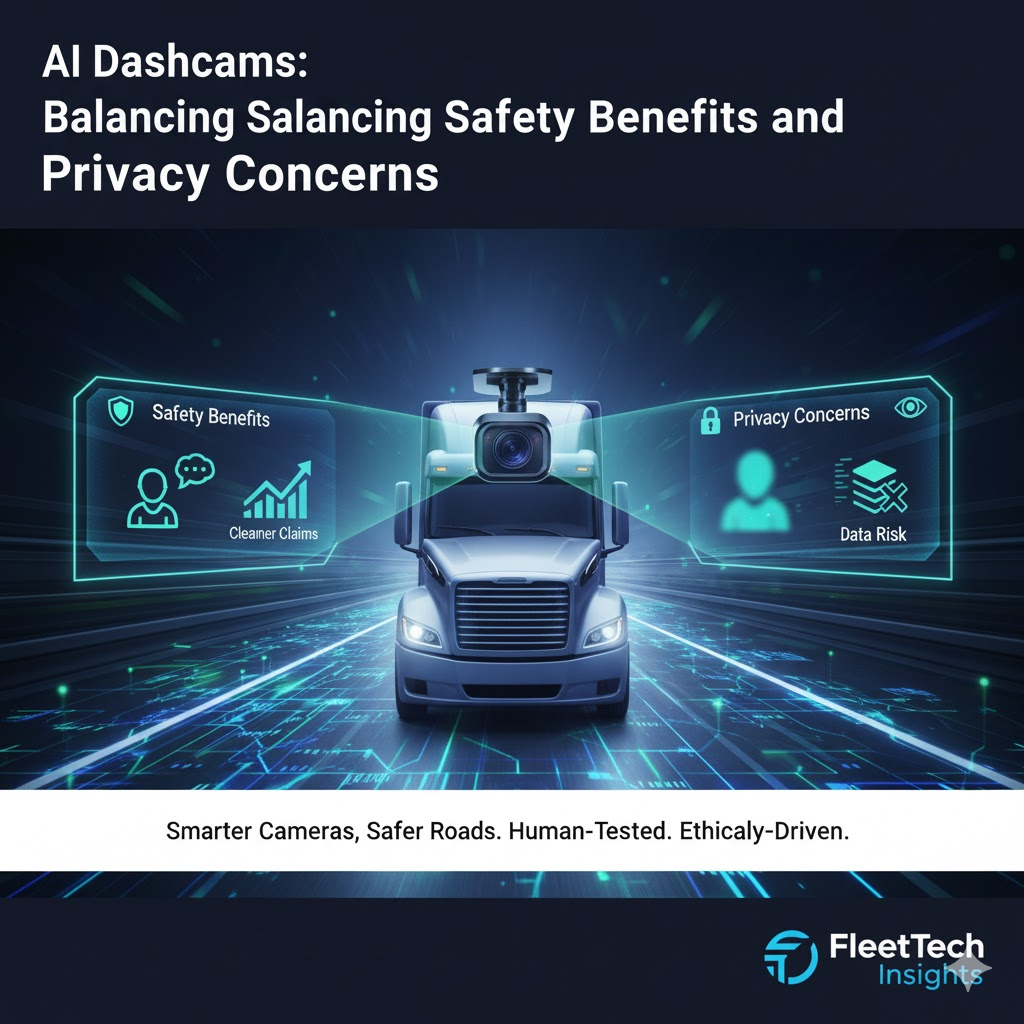
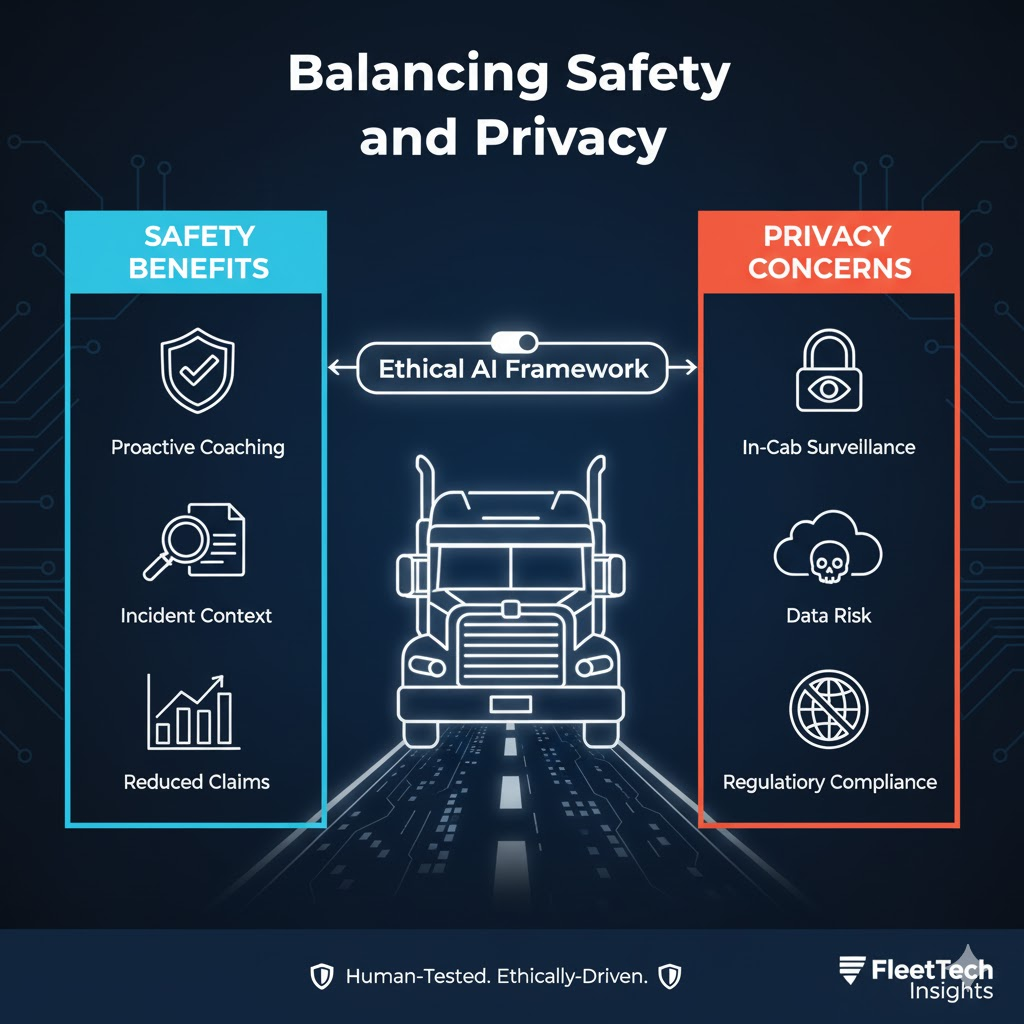
The pitch is simple: smarter cameras, safer roads. Used well, AI dashcams turn raw video into real-time coaching, incident context, and cleaner claims—without burying your team in footage. Used poorly, they feel like surveillance, spike distrust, and create data risk. This guide sorts the signal from the noise so fleet managers can boost vehicle safety and road safety while respecting people and the law.
Pros of AI Dashcams
Enhanced Safety
Video + analytics change behavior. In naturalistic-truck studies, video-based monitoring with coaching cut safety-critical events for commercial drivers—reductions reported across multiple fleets when feedback is consistent.
Even outside pure camera analytics, adding ADAS signals (e.g., lane departure warnings, forward-collision alerts) reduces crash risk for heavy trucks, reinforcing the value of instrumented vehicle technology.
Where AI adds value
- Risk prediction models flag rising risk (e.g., accelerating driver fatigue + distracted driving patterns).
- Real time alerts help drivers self-correct before an event (speeding, tailgating, stop-sign roll).
- Edge-side scoring simplifies driver coaching feedback and lowers review time.
Improved Insurance Claims
Clear video shortens the insurance claim workflow and reduces disputes. Many fleets report insurance savings through lower insurance premiums or deductibles when they can provide high-quality video evidence standards within hours. Vendor market data in 2025 also indicates fewer severe losses when video-telematics is paired with coaching—severe collisions (Level 1) down 6%, moderate severity down 59% in one large dataset.
Driver Behavior Analysis
With careful rollout, driver monitoring systems move from “gotcha” to “growth.” Objective clips enable targeted driver training, while trend lines support fleet safety programs (e.g., high-frequency hard-brake corridors that need routing fixes). Combined with fleet telemetry integration (engine speed, speed monitoring, location), you get incident context—not just pictures.
Cons of AI Dashcams
Privacy Concerns
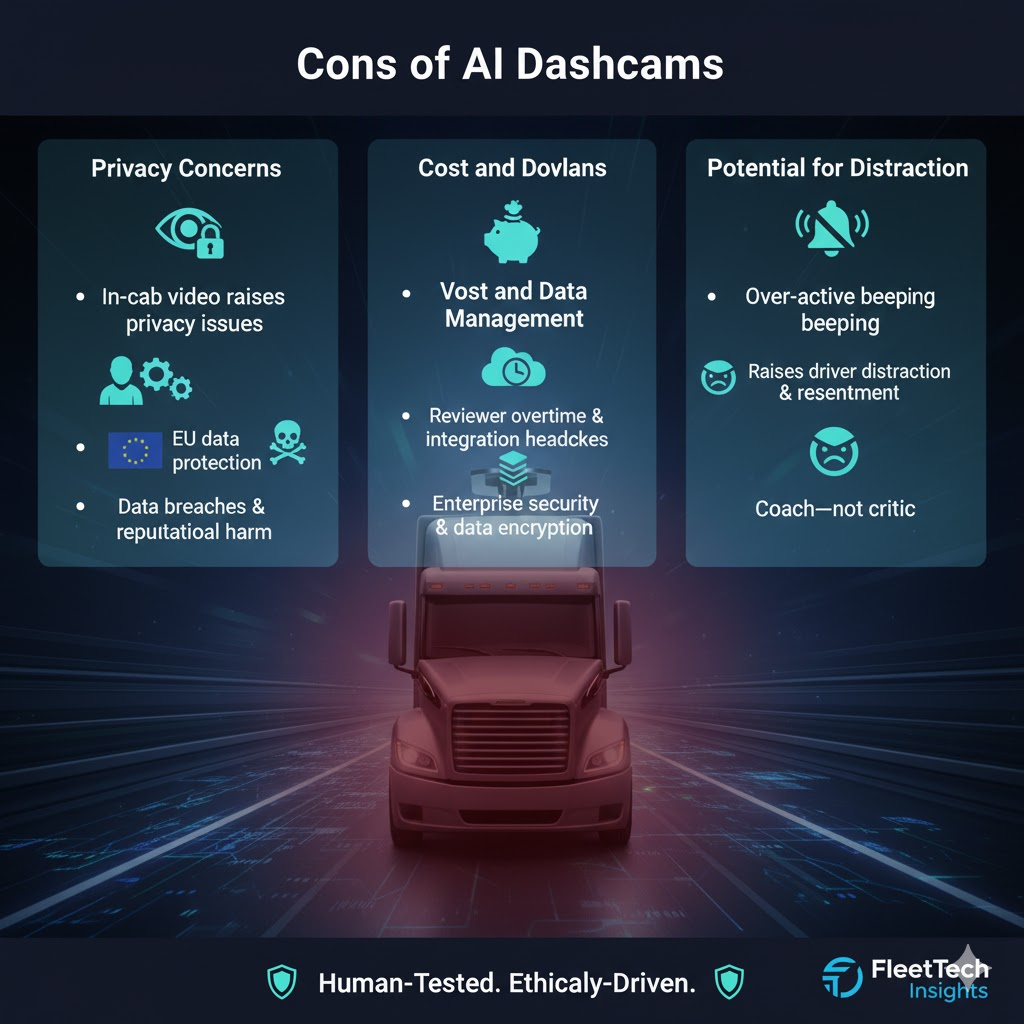
In-cab video raises privacy issues, surveillance ethics, and ethical concerns, especially for inward-facing cameras and audio. In the EU, dashcam processing intersects data protection and employment monitoring; the EDPB stresses purpose limitation, proportionality, and lawful basis.
Poor controls increase the chance of data breaches, shaky consent, and reputational harm.
Cost and Data Management
“Set it and forget it” becomes video storage costs, reviewer overtime, and integration headaches. Without data minimization and data retention policies, storage balloons. Add cloud copies, and your enterprise security and data encryption standards must be airtight.
Potential for Driver Distraction
Bad UX can backfire. Over-active beeping raises driver distraction metrics and resentment. Alerts must be tuned; the system should be coach—not critic.
Real-World Impact Metrics
Table 1 — Evidence snapshot (independent + industry)
| Outcome | Context | Reported result | Source |
| Fewer safety-critical events after video-based monitoring + coaching | Naturalistic commercial driving | Reductions in at-risk events (range reported across fleets) | |
| Forward collision warning/AEB effectiveness for large trucks | Crash-based analysis | Significant crash-risk reduction | |
| Change in collision severity with video telematics + coaching | 300B-mile vendor dataset (2025) | Level-1 collisions −6%; Level-2 −59% vs. prior year |
Use vendor metrics to benchmark internally, not as universal truth. Pair them with your own baselines and targets.
Safety Improvements
Track leading indicators (coachable risky events per 100 hours) and lagging indicators (preventable crashes per million miles). The best programs tie alert thresholds to risk deltas, not generic defaults.
Insurance Savings
Ask underwriters which certifications, devices, or regulatory compliance practices earn credits. Savings often hinge on policy structure, proof of coaching, and reliable data exports.
Balancing Safety and Privacy
Implementing Privacy Controls
“Trust by design” beats PR after the fact. Bake privacy into rollout, not as paperwork later.
Table 2 — Privacy control map (what, why, how)
| Control | Why it matters | How to implement |
| Data minimization | Less data = lower exposure | Record road-facing by default; enable cab view only for coaching/jobs requiring it. Blur faces/plates by default where lawful. |
| Edge computing | Reduce cloud dependency | Classify events on-device; upload short clips, not hours of raw video. |
| Anonymization techniques | Lower identifiability in analytics | Hash driver IDs for dashboards; store linkage in a separate vault. |
| Consent management | Respect rights; improve legitimacy | Signed acknowledgments + posted notices; capture consent changes and reasons. |
| Data retention policies | Control data storage sprawl | 30–90 days for non-events; extended retention only for claims/discipline with ticket number. Auto-purge everywhere. |
| User access controls | Prevent snooping | RBAC; least privilege; session timeouts; audit trails for clip access. |
| Data encryption standards | Protect in transit/at rest | TLS 1.2+; device-unique keys; customer-managed keys if supported. |
| Cross border data transfer | Avoid unlawful exports | Keep EU data in EU-hosted clouds; SCCs/transfer impact assessments when needed. |
| Privacy by design | Institutionalize good defaults | DPIA before rollout; document purposes, lawful basis, and alternatives. |
| Incident response planning | Prepare for the bad day | 72-hour notification playbook, contact tree, and pre-drafted comms for drivers/regulators. |
| Video evidence standards | Ensure admissibility | Time sync, watermarking, immutable logs; chain-of-custody export process. |
| AI decision transparency | Avoid black-box coaching | Explain alert logic; let drivers review their own events with policy context. |
Legal and Ethical Considerations
- Regulatory compliance: In North America, align to labor and privacy laws; in the EU/UK, follow GDPR/UK GDPR and national guidance on employee monitoring. EDPB guidance for connected vehicles is your north star.
- Liability considerations: If you collect it, you may have to produce it. Retention bloat can enlarge discovery scope.
- Ethical data use: No fishing expeditions. Use footage strictly for accident prevention, risk management, and training as stated in your privacy policies.
Steps to a Successful Rollout (with cost/ops realism)
Table 3 — 30-day adoption plan (technology adoption + trust)
| Week | What to do | Owner | Outputs |
| 1 | Define purposes; run DPIA; choose road-only default | Compliance + Ops | Written policy; retention schedule; consent forms |
| 1–2 | Pilot 10 vehicles; tune alerts; prove data integrity | Safety + IT | Baselines; false-alert rate < 5%; coach flow |
| 2 | Build coaching SOP; schedule 15-min weekly reviews | Safety | Playbook for driver coaching feedback |
| 3 | Train drivers (live demos; Q&A) | Safety + HR | Signed acknowledgments; feedback log |
| 3–4 | Scale to 25% of fleet; monitor real time alerts | Dispatch + IT | Exception dashboard; SLA on triage |
| 4 | Audit access; test exports for insurance premiums credits | Compliance + Claims | Evidence pack; audit trail check |
Cost analysis (make it pencil)
- Capex/Opex: camera(s), installation, data plan, storage tier, reviewer time.
- Offset: crash reduction, insurance savings, fraud defense, faster insurance claim workflow, operational coaching benefits (fuel, tires).
- Video storage costs fall fast when you store events, not everything. Use on-device rules to keep upload minutes low.
Cons Revisited—How to Avoid the Pitfalls
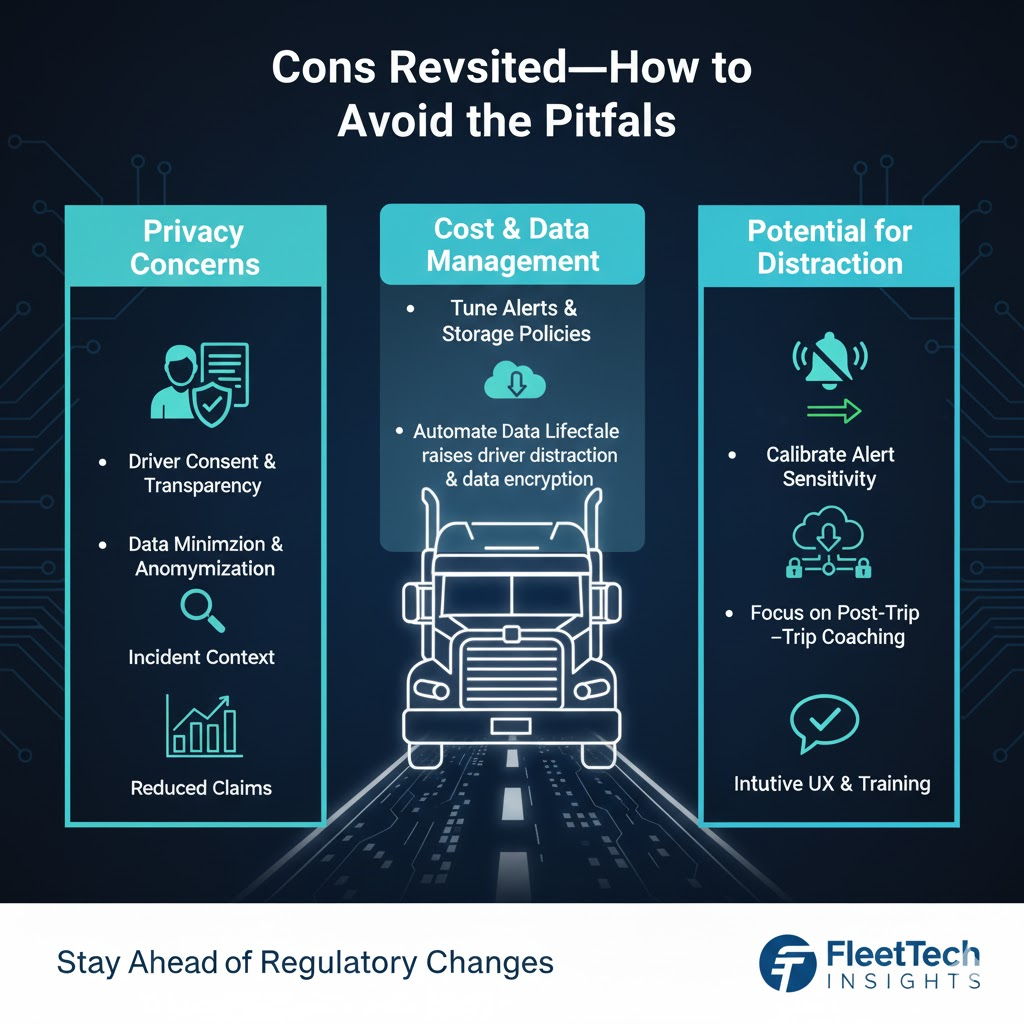
- Driver mistrust → Involve drivers early; publish a one-page “what we collect/why/how long.” Let drivers review their own events in app.
- Alert fatigue → Start conservative; measure and lower driver distraction metrics; mute non-safety alerts above 45 mph.
- Data sprawl → Enforce data retention policies and automated deletion; quarterly audits.
- Security gaps → Device hardening, signed firmware, remote diagnostics only via VPN, MDM for updates, and rapid recall integration when vendors patch vulnerabilities.
- Shadow IT → Centralize admins; rotate keys; quarterly RBAC review.
What Good Looks Like (policy excerpts you can steal)
Purpose statement (short):
“We use road-facing video and selected performance signals to improve fleet management, fleet safety, and claims outcomes. In-cab video (if enabled) is for coaching and serious incident review only. We don’t use cameras for time-keeping or off-duty monitoring.”
Retention:
“Non-events: 30–60 days; events with tickets/claims: until closed + 2 years (or statutory). Auto-purge enforced system-wide.”
Access:
“Only trained reviewers and designated supervisors with RBAC; all access logged. Drivers can request their footage per policy.”
Transfer/export:
“EU footage stored in-region; exports under SCCs where applicable. Encryption at rest and in transit.”
Feature Checklist (build vs buy)
- Incident analytics with tunable thresholds
- Risk prediction models that combine video + CANbus
- Edge computing for on-device classification
- Data encryption standards (TLS 1.2+/AES-256)
- User access controls (SSO, RBAC, audit logs)
- Data minimization (clip-only upload; no always-on mic)
- Data storage controls (hot/warm tiers; lifecycle rules)
- Consent management & driver app acknowledgments
- API for fleet telemetry integration (hours, GPS, maintenance, remote diagnostics)
- Regulatory compliance kit (policy templates, data retention policies)
- AI decision transparency (explainable cues in each alert)
- Road hazard detection tie-ins (work zones, debris)
- Technology adoption support (playbooks, reporting)
Frequently Compared Approaches (no vendor names)
Road-only camera + G-force
- Pros: Lowest privacy footprint; cheapest storage; strong for claims.
- Cons: Weaker context for coaching; fewer real time alerts.
- Best for: Small fleets starting out.
Dual-facing with event-based in-cab
- Pros: Strong for coaching and accident prevention; supports nuanced driver behavior trends.
- Cons: Higher privacy bar; requires careful policy and consent management.
- Best for: Safety-mature fleets with coaching culture.
Dual-facing continuous + cabin audio
- Pros: Maximum context for complex incidents.
- Cons: Highest privacy and storage burden; invites legal implications.
- Best for: Rare exceptions with clear lawful basis and union/legal approval.
Metrics That Matter (and how to present them)
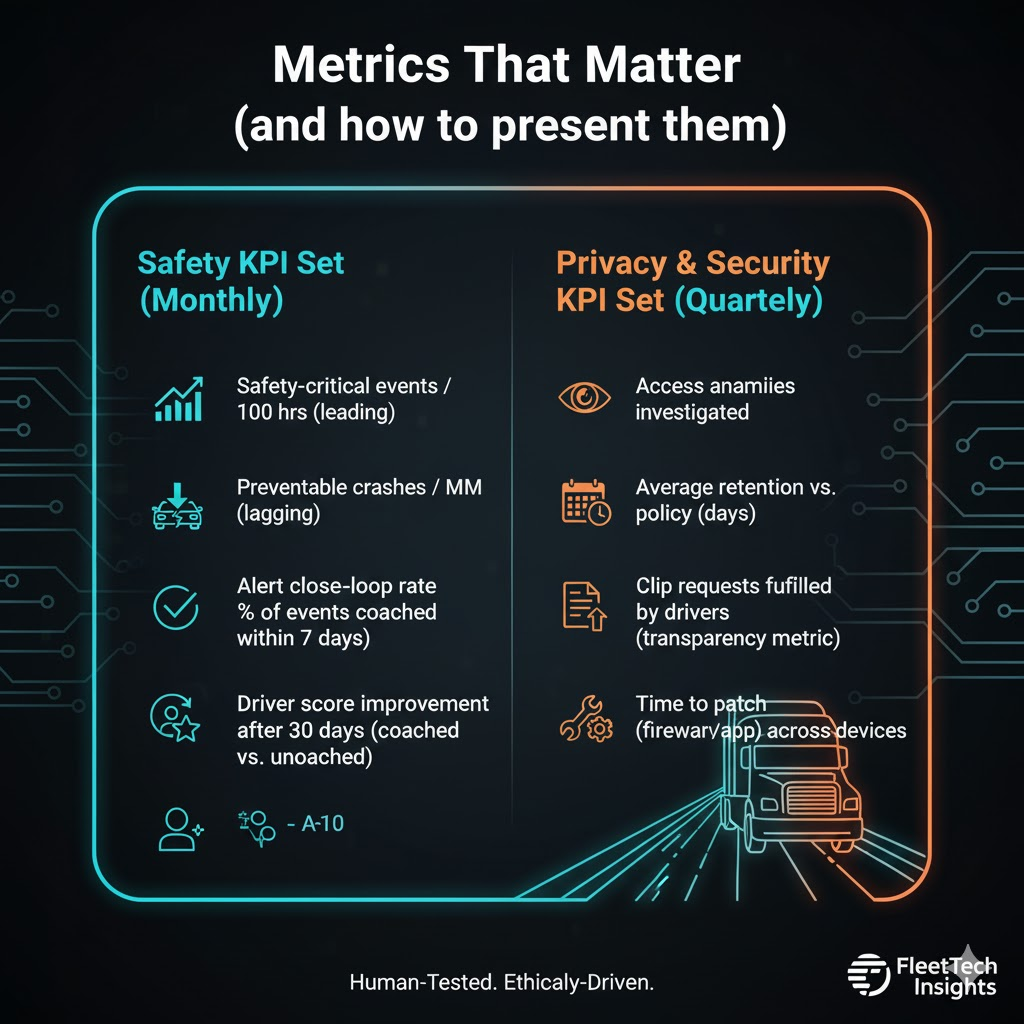
Safety KPI set (monthly):
- Safety-critical events / 100 hrs (leading)
- Preventable crashes / MM (lagging)
- Alert close-loop rate (% of events coached within 7 days)
- Driver score improvement after 30 days (coached vs. uncoached)
Privacy & security KPI set (quarterly):
- Access anomalies investigated
- Average retention vs. policy (days)
- Clip requests fulfilled by drivers (transparency metric)
- Time to patch (firmware/app) across devices
Present both sets in one page: safety improves and rights respected.
Conclusion
Cameras don’t make people safer—habits do. The right stack helps people build those habits faster. Roll out AI dashcams with clear purpose, limited capture, and tight governance, and you’ll see fewer crashes, faster claims, and better conversations in coaching. Roll them out as surveillance, and you’ll get pushback, noise, and risk. Choose privacy by design, tune alerts to behavior, and measure what matters; your drivers—and your bottom line—will show you it works.
Notes & Sources
- Video-based monitoring + coaching reduces at-risk events in commercial fleets.
- Forward-collision warning/AEB effectiveness for large trucks (IIHS).
- 2025 vendor dataset on severity reduction with video telematics + coaching.
- EU privacy guidance for connected vehicles and employment contexts (EDPB).
- AAA Foundation overview on video-based onboard safety systems (cost/benefit framing).