One of the most common questions people ask before entering the trucking industry is: Can you become a truck driver without any previous experience?
The short answer is yes.
Many professional truck drivers in the United States started with no commercial driving experience at all. Trucking is one of the industries where companies regularly hire newly licensed drivers and provide additional training before allowing them to operate independently.
However, "no experience" does not usually mean you can simply get into a semi-truck and start working.
If you want to drive a tractor-trailer professionally, you will generally need the appropriate Commercial Driver's License (CDL), complete required training, pass the necessary tests, and find an employer willing to hire entry-level drivers.
This guide explains how to become a truck driver without experience, what new drivers should expect from their first job, and how to improve your chances of getting hired.
Can You Really Get a Trucking Job With No Experience?
Yes.
Many trucking companies hire drivers who have recently earned their CDL but have zero professional truck-driving experience.
These drivers are usually classified as:
- Entry-level drivers
- New CDL graduates
- Recent CDL graduates
- Student drivers
- Trainee drivers
- First-year drivers
The exact terminology depends on the company.
Large carriers in particular often have structured programs designed specifically for new CDL holders.
Instead of expecting you to already have a year or two of experience, these employers may provide additional company training and put you with an experienced driver trainer before allowing you to drive solo.
This creates a common path into the industry:
CDL training → CDL license → company orientation → driver trainer → solo driving
You do not need several years of previous truck-driving experience to begin.
You do need to meet the company's hiring standards and demonstrate that you can operate a commercial vehicle safely.
No Experience and No CDL Are Not the Same Thing
This distinction is important.
You can become a professional truck driver with no previous experience, but you generally cannot operate a typical tractor-trailer professionally without the required CDL.
For most people interested in driving semi-trucks, that means obtaining a Class A CDL.
A Class A CDL is commonly used for combination vehicles such as tractor-trailers.
If you do not yet have a CDL, your first goal is not finding a solo trucking job.
Your first goal is completing the licensing process.
Once you have your CDL, you can begin applying for positions that specifically accept newly licensed drivers.
What Is Considered Truck-Driving Experience?
When a trucking company asks for experience, it normally means verifiable professional experience operating commercial vehicles.
For example, a job posting might require:
- 3 months of tractor-trailer experience
- 6 months of CDL experience
- 12 months of experience
- 2 years of commercial driving experience
Driving:
- Pickup trucks
- Cars
- Cargo vans
- Personal trailers
usually does not count as Class A tractor-trailer experience.
Even completing CDL school does not necessarily mean that an employer will consider you an "experienced driver."
You have learned the fundamentals, but you are still beginning your professional career.
That is why you should look specifically for jobs labeled:
- No Experience Required
- Recent CDL Graduates
- Entry-Level CDL Drivers
- CDL-A Trainees
- Student Drivers Welcome
Why Do Trucking Companies Hire Drivers With No Experience?
It might seem surprising that a company would allow someone with very little experience to operate expensive equipment.
There are several reasons.
Companies Need New Drivers
Every experienced driver was once a beginner.
Carriers need a way to bring new people into the industry as experienced drivers retire, change careers, or move to other companies.
The U.S. Bureau of Labor Statistics projects about 237,600 openings for heavy and tractor-trailer truck drivers per year on average from 2024 through 2034, with many openings resulting from workers leaving the occupation or labor force.
Large Carriers Have Training Programs
Large trucking companies may operate:
- Training departments
- Driving schools
- Orientation centers
- Driver trainers
- Training terminals
Because these systems already exist, they can hire inexperienced drivers and gradually introduce them to real-world operations.
Companies Can Train Drivers to Their Standards
Hiring a new driver gives a carrier the opportunity to teach that driver its own:
- Safety procedures
- Equipment
- ELD system
- Fueling procedures
- Customer requirements
- Dispatch system
- Company policies
For some carriers, training a motivated new driver can make sense.
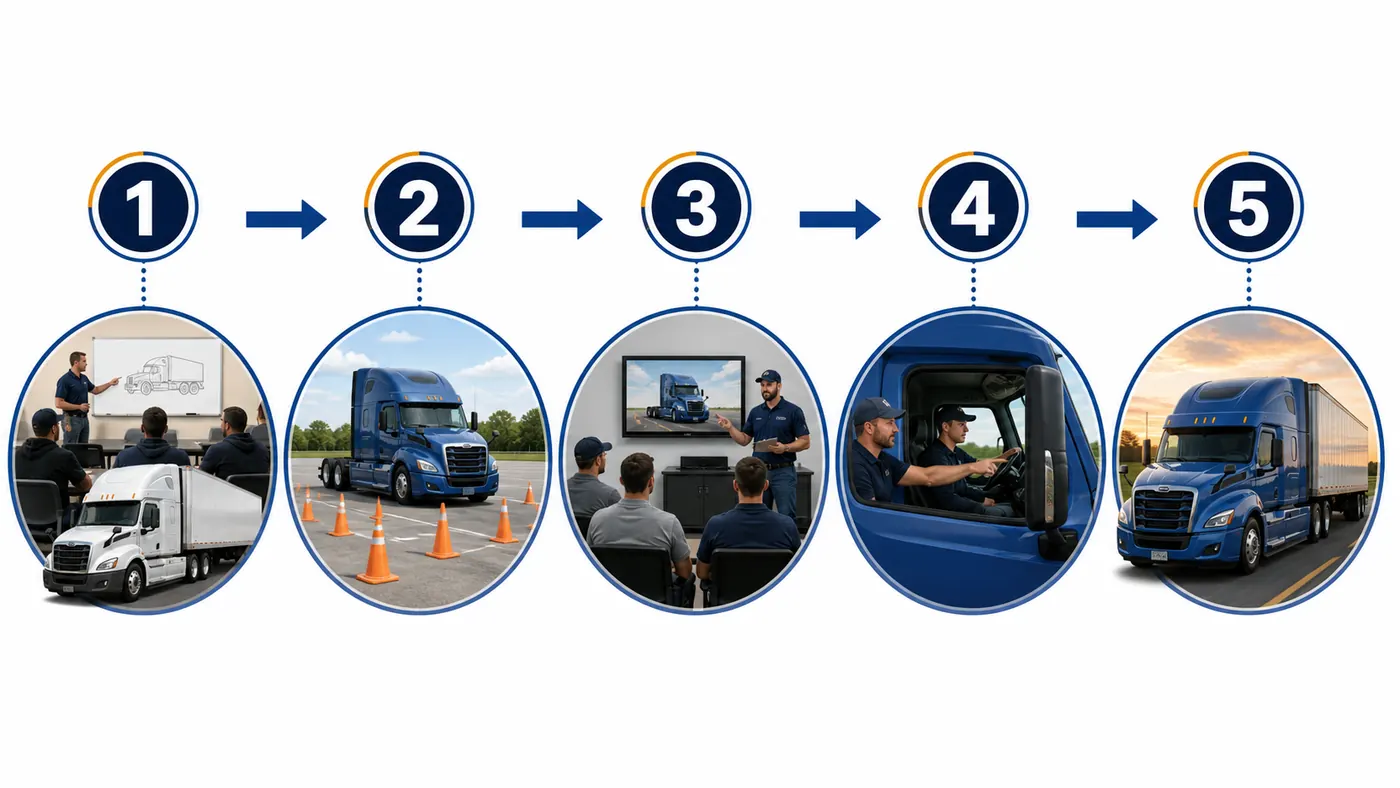
Step 1: Decide What Type of CDL You Need
If your goal is to drive standard tractor-trailers, you will typically want a Class A CDL.
Class A drivers may work in areas such as:
- OTR trucking
- Regional trucking
- Dedicated routes
- Dry van
- Reefer
- Flatbed
- Tanker
- Intermodal transportation
Class B licenses are commonly associated with certain:
- Straight trucks
- Dump trucks
- Large buses
- Delivery vehicles
- Other heavy single vehicles
Before beginning training, decide what type of truck-driving career you want.
For someone who wants the broadest access to traditional semi-truck jobs, Class A is generally the most relevant option.
Step 2: Get a Commercial Learner's Permit
Before earning your full CDL, you will normally obtain a Commercial Learner's Permit (CLP).
This involves passing the required knowledge tests for your license class and applicable endorsements.
Study materials are available through your state's official CDL manual.
Subjects can include:
- General knowledge
- Air brakes
- Combination vehicles
- Vehicle inspections
- Safe driving
- Cargo
- Railroad crossings
- Emergency procedures
Under federal rules, a CLP generally must be held for at least 14 days before the CDL skills test can be taken.
Your state may have additional requirements.
Step 3: Complete Required Entry-Level Driver Training
If you are obtaining a Class A or Class B CDL for the first time, federal Entry-Level Driver Training (ELDT) requirements generally apply.
The training must be completed with a provider listed in the FMCSA Training Provider Registry before you can take the applicable CDL skills test.
For a first-time Class A CDL, ELDT includes both theory and behind-the-wheel training.
The purpose of this training is to teach new drivers the fundamental knowledge and skills needed to operate commercial vehicles safely.
Training may cover areas such as:
- Vehicle inspections
- Basic vehicle control
- Straight-line backing
- Offset backing
- Road driving
- Shifting when applicable
- Turns
- Railroad crossings
- Communications
- Hours of Service
- Trip planning
- Cargo considerations
Your state can also impose requirements beyond the federal minimum.
Step 4: Practice Behind the Wheel
This is where you begin developing actual truck-driving skills.
Learning to operate a tractor-trailer is very different from driving a passenger vehicle.
New drivers need practice with:
- Wide turns
- Mirror use
- Lane positioning
- Braking
- Acceleration
- Following distance
- Trailer tracking
- Backing
- Dock approaches
- Vehicle inspections
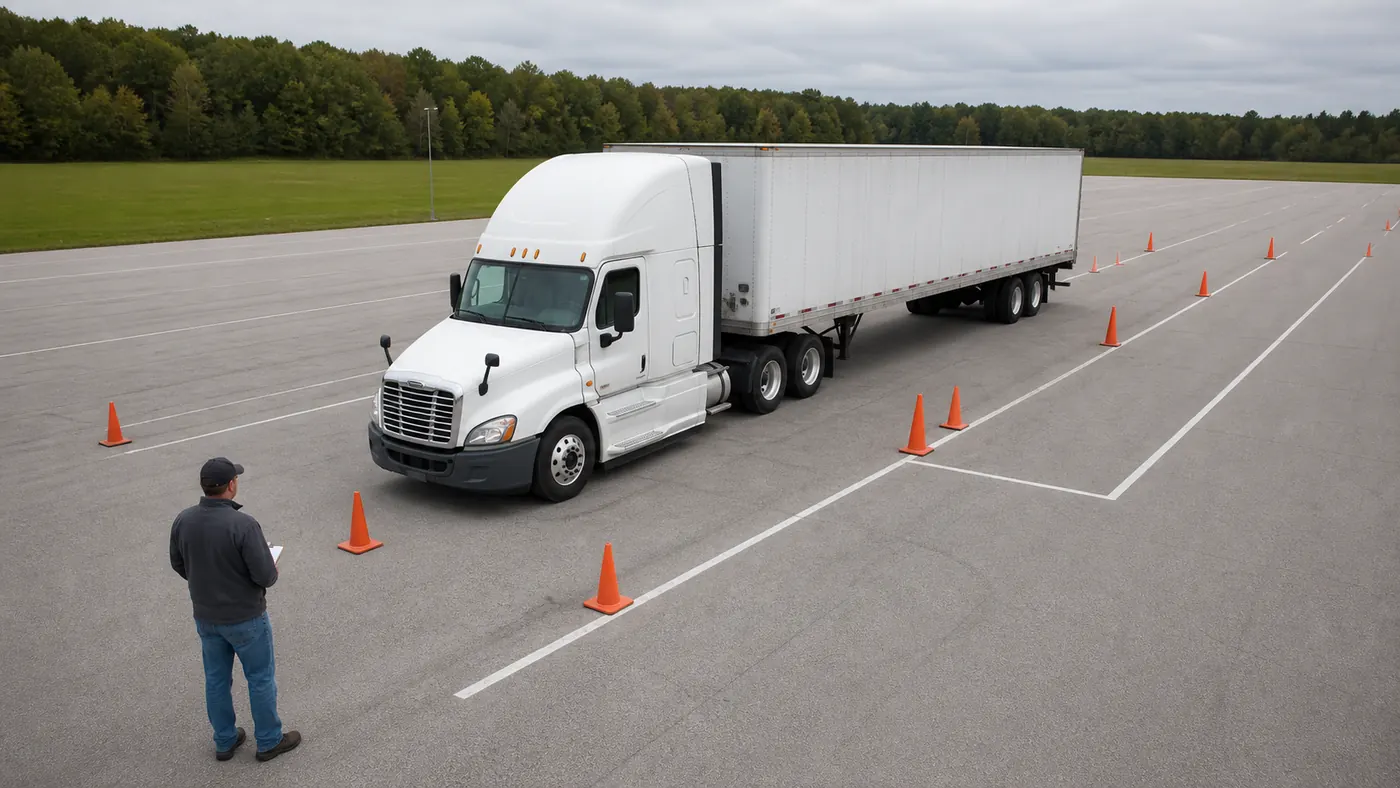
Backing is often one of the most difficult skills for beginners.
At first, understanding how steering inputs affect a 53-foot trailer can feel confusing.
Practice gradually builds the connection between what you see in the mirrors and what the trailer is actually doing.
Do not worry if you are not perfect immediately.
Professional truck driving is a skill that develops with repetition.
Step 5: Pass the CDL Skills Test
After meeting the applicable requirements, you will need to pass your CDL skills test.
Testing generally evaluates areas such as:
- Vehicle inspection
- Basic vehicle-control skills
- On-road driving
The exact process can vary by state.
Once you successfully complete the required tests and licensing requirements, your state can issue your CDL.
At this point, you are legally licensed — but you are still an inexperienced professional driver.
That is where choosing your first employer becomes important.
Step 6: Apply to Entry-Level Trucking Companies
When searching for your first job, do not waste all your time applying to positions that clearly require two years of experience.
Look specifically for carriers that hire recent graduates.
Useful search terms include:
- CDL Class A no experience
- Entry-level CDL driver
- Recent CDL graduate
- CDL trainee
- New CDL driver
- Student truck driver
- Paid CDL training
Read the job description carefully.
A company may require:
- Graduation from an approved CDL school
- A minimum age
- A valid medical qualification
- Acceptable driving history
- Successful drug screening
- Background verification
- Ability to meet company insurance requirements
Each carrier can establish hiring standards beyond basic licensing requirements.
What Do Employers Check Before Hiring New Drivers?
Having a CDL does not automatically guarantee that every company will hire you.
Employers normally review several factors.
Driving Record
A clean or reasonably good motor vehicle record can significantly improve your opportunities.
Companies may review violations such as:
- Speeding
- Reckless driving
- DUI/DWI
- License suspensions
- Serious accidents
Different carriers have different standards.
CDL Status
Your CDL must be valid and appropriate for the equipment you will operate.
Restrictions on your CDL may affect which trucks you can drive.
Medical Qualification
Interstate commercial drivers subject to FMCSA physical-qualification rules generally must meet federal medical standards.
Drug and Alcohol Compliance
CDL drivers in covered safety-sensitive positions are subject to federal drug and alcohol testing requirements.
For applicable drivers, employers conduct required pre-employment controlled-substance testing and use the FMCSA Drug and Alcohol Clearinghouse as part of the hiring process.
Employment History
Companies may review your previous employment even if that employment had nothing to do with trucking.
A stable history can help demonstrate reliability.
Criminal Background
Some carriers perform criminal-background checks.
A record does not necessarily mean that every trucking company will reject an applicant, but eligibility depends on the company, offense, time passed, customers, insurance requirements, and applicable laws.
What Happens After a Company Hires You?
New drivers often do not immediately receive truck keys and leave on a 2,000-mile solo trip.
Most entry-level programs include several stages.
Orientation
Company orientation may cover:
- Safety rules
- Company policies
- ELD operation
- Hours of Service
- Trip planning
- Fuel procedures
- Maintenance reporting
- Accident procedures
- Customer requirements
- Cargo procedures
Drivers may also complete paperwork, tests, and evaluations.
Road Evaluation
Some employers require a road test or skills evaluation.
The company wants to confirm that you can safely control the vehicle before continuing the hiring or training process.
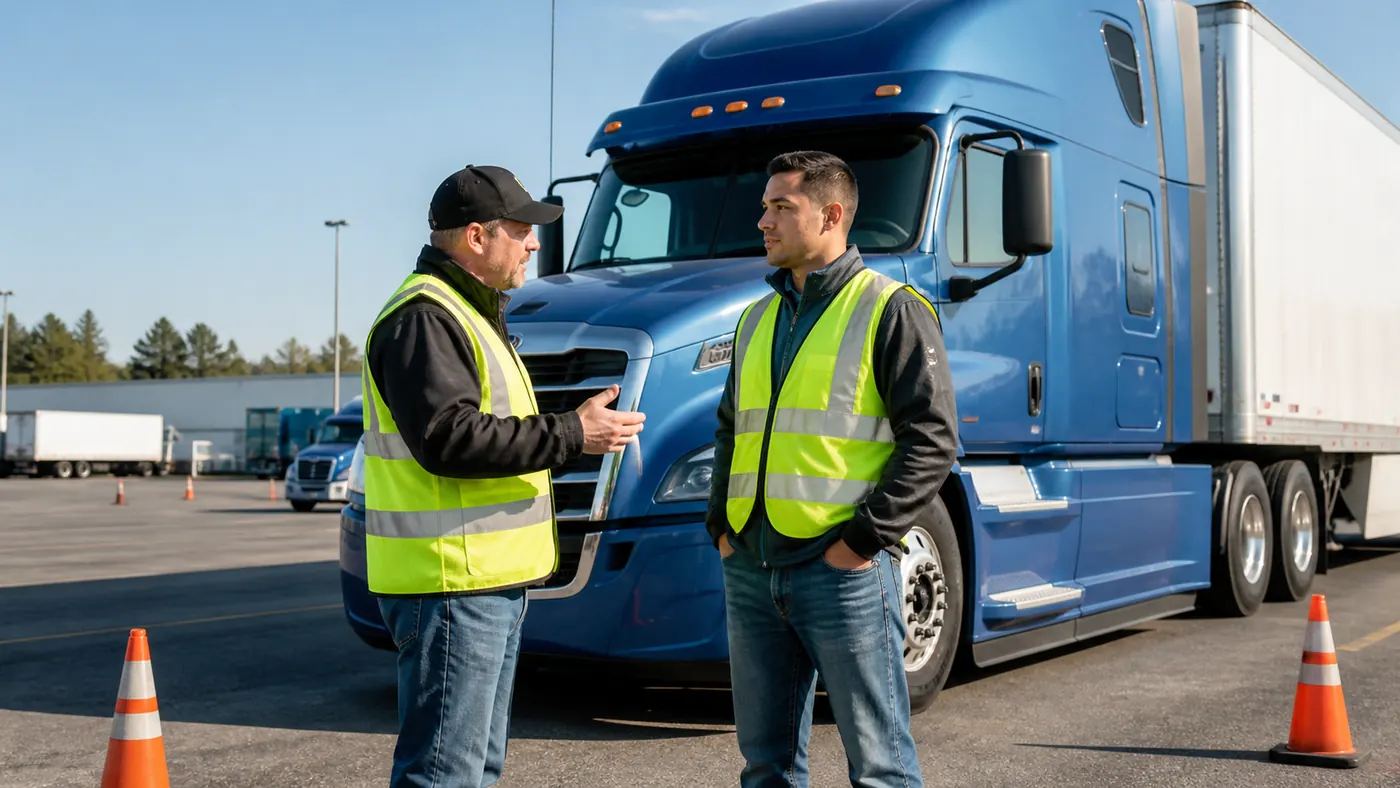
Training With an Experienced Driver
Many inexperienced drivers spend time with a company trainer.
The trainer can help teach real-world skills that are difficult to learn entirely at CDL school.
These may include:
- Planning a 500-mile day
- Finding truck parking
- Fueling efficiently
- Using weigh stations
- Sliding tandems
- Scaling loads
- Checking into warehouses
- Backing into crowded docks
- Communicating with dispatch
- Managing an ELD
- Handling weather and traffic
The amount of training varies considerably by company.
Some programs use a fixed number of weeks, while others use mileage, evaluations, or demonstrated skill levels.
When Do You Get Your First Solo Truck?
After completing company training and passing any required evaluations, you may be released to drive independently.
This is often called:
- Going solo
- Solo qualification
- Upgrade
- Driver upgrade
Receiving your first assigned truck can be exciting, but it is also when your responsibility increases significantly.
Now you may have to handle your own:
- Pre-trip inspections
- Route planning
- Fuel planning
- Parking decisions
- Deliveries
- Backing
- ELD management
- Communication with dispatch
Your trainer is no longer sitting beside you.
That is why the first several months of professional driving are an important learning period.
Is OTR Trucking Good for Drivers With No Experience?
OTR trucking is one of the most common entry points for new CDL drivers.
Large OTR carriers frequently operate training programs because they have:
- Large fleets
- Dedicated trainers
- Nationwide freight
- Training terminals
- Structured orientation programs
OTR also gives new drivers exposure to many different situations.
During your first months, you may encounter:
- Interstate highways
- Large distribution centers
- Different states
- Mountain roads
- Heavy traffic
- Winter weather
- Truck stops
- Tight docks
- Different freight customers
This can help you build experience relatively quickly.
The disadvantage is that OTR drivers may remain away from home for days or weeks at a time.
For some new drivers, that is acceptable.
For others, regional or local work may be a better choice.
Can You Get a Local Trucking Job With No Experience?
Yes, but it can sometimes be more difficult.
Some local trucking jobs accept new CDL graduates, while others require previous tractor-trailer experience.
Local driving can actually require significant skill because drivers may deal with:
- Heavy city traffic
- Tight streets
- Frequent stops
- Difficult docks
- Repeated backing
- Customer interaction
Certain employers therefore prefer drivers who already have several months of professional experience.
However, entry-level local positions do exist.
Possible areas include:
- Food and beverage delivery
- Construction
- Waste collection
- Local distribution
- Moving companies
- Certain Class B operations
Requirements vary widely.
If your priority is being home every night, it is worth searching for local jobs even as a new driver.
What About Regional Trucking?
Regional trucking can provide a middle ground between local and OTR work.
Regional drivers normally operate within a defined area of the country.
For example:
- Midwest
- Northeast
- Southeast
- Southwest
- West Coast
Some regional positions allow drivers to return home weekly or several times per week.
Companies that operate large regional fleets may also accept new CDL graduates.
Which Trailer Type Is Best for a New Driver?
There is no universal answer, but dry van trucking is a common starting point.
Dry vans transport general freight inside enclosed trailers.
New drivers can focus on developing fundamental skills such as:
- Backing
- Docking
- Trip planning
- Pre-trip inspections
- Weight distribution
- Hours-of-Service management
without some of the additional tasks associated with specialized freight.
Reefer
Refrigerated trucking can also hire entry-level drivers.
However, drivers must pay attention to:
- Trailer temperatures
- Reefer fuel
- Customer requirements
- Longer loading and unloading times in some operations
Flatbed
Some flatbed companies hire new drivers and provide securement training.
Flatbed drivers must learn additional skills involving:
- Straps
- Chains
- Binders
- Tarps
- Cargo securement
Tanker
Some tanker jobs accept less experienced drivers, while others require prior experience.
Additional endorsements may also be necessary.
How Much Can a New Truck Driver Make?
There is no single starting salary for new CDL drivers.
Pay can depend on:
- Company
- Route
- Mileage
- Freight type
- Location
- Bonuses
- Endorsements
- Training status
- Solo vs. team operation
Many OTR company drivers are paid by the mile.
Other trucking jobs may use:
- Hourly pay
- Daily pay
- Salary
- Percentage of load revenue
- Combination pay systems
The Bureau of Labor Statistics reported a median annual wage of $57,440 for heavy and tractor-trailer truck drivers in May 2024, but this figure includes drivers at different experience levels and should not be treated as a guaranteed starting salary for a new driver.
When comparing entry-level jobs, do not look only at the advertised cents-per-mile rate.
Also ask about:
- Average weekly miles
- Training pay
- Detention pay
- Layover pay
- Breakdown pay
- Extra-stop pay
- Bonuses
- Home time
A higher advertised mileage rate does not necessarily result in higher weekly income if the available miles are low.
How Can You Improve Your Chances of Getting Hired?
New drivers cannot instantly create experience, but they can make themselves more attractive to employers.
Keep Your Driving Record Clean
Avoid unnecessary traffic violations.
Your personal driving history matters when applying for commercial driving positions.
Take CDL Training Seriously
Do not study only enough to pass the test.
Try to actually understand:
- Inspections
- Air brakes
- Combination vehicles
- Backing
- Safe following distance
- Hours of Service
These fundamentals will continue to matter after you receive your CDL.
Practice Backing
Backing is one of the biggest challenges for new drivers.
Practice in safe training environments whenever possible.
Focus on:
- Straight-line backing
- Offset backing
- Driver-side backing
- Trailer control
- Mirror use
Consider Useful Endorsements
Depending on your career goals, additional endorsements can expand your options.
Examples include:
- Tanker
- Hazmat
- Double/Triple Trailers
Do not obtain endorsements simply because someone tells you that every driver needs them.
Choose endorsements that match the jobs you want.
Be Flexible With Your First Job
Your first trucking job may not have:
- The highest pay
- The newest truck
- The perfect schedule
- The best home time
- Your preferred route
Sometimes the first job is primarily about building safe professional experience.
After you have developed a solid employment and safety record, additional opportunities may become available.
What Should You Ask an Entry-Level Trucking Company?
Before accepting your first job, ask questions.
Important questions include:
- Do you hire drivers with zero experience?
- How long is orientation?
- How long will I be with a trainer?
- Is training paid?
- How much does training pay?
- What happens before I am released solo?
- What is the normal starting pay?
- How many miles do new drivers typically receive?
- How often will I be home?
- Is freight mostly live load or drop-and-hook?
- What equipment do new drivers receive?
- Is detention paid?
- Is breakdown time paid?
- Are there driver-facing cameras?
- What happens if I decide the job is not a good fit?
Do not be afraid to ask detailed questions before signing an employment or training agreement.
Be Careful With CDL Training Contracts
Some carriers offer company-sponsored CDL training.
This can reduce the amount of money you need upfront, but you should understand the agreement.
A program may require you to work for the company for a certain period after training.
If you leave early, you may be responsible for some training costs.
Before signing anything, understand:
- Total training cost
- Required employment period
- Repayment terms
- Training pay
- Housing costs
- Transportation costs
- What happens if you fail training
- What happens if the company terminates you
Read the actual agreement rather than relying only on what a recruiter says.
Common Mistakes New CDL Drivers Make
The first year of trucking involves a lot of learning.
Avoiding several common mistakes can make the transition easier.
Trying to Drive Like an Experienced Driver
Do not compare yourself with someone who has been driving for 20 years.
Take your time.
Rushing Backing Maneuvers
If you are unsure about your clearance:
Stop and GOAL — Get Out And Look.
It is better to take several extra minutes than damage a truck or trailer.
Following GPS Without Checking the Route
A regular car GPS can send a truck toward:
- Low bridges
- Weight-restricted roads
- Residential streets
- Roads prohibited to trucks
Use truck-appropriate routing and verify your route.
Ignoring Small Mechanical Problems
A small issue can become a major roadside breakdown.
Report problems early.
Poor Trip Planning
Know where you will:
- Fuel
- Stop
- Deliver
- Take breaks
- Park
before you need those things.
Letting Other People Rush You
Dispatchers, customers, and other drivers may be impatient.
That does not change your responsibility to operate safely.
How Long Does It Take to Stop Feeling Like a New Driver?
There is no exact number.
Some drivers become comfortable relatively quickly, while others need more time.
You may notice different stages.
First Few Weeks
Almost everything feels new.
You think carefully about every turn, dock, fuel stop, and parking maneuver.
First Few Months
Basic tasks begin to feel more natural.
You understand how the truck moves and become more efficient at trip planning.
After More Real-World Experience
You begin recognizing situations earlier.
You anticipate:
- Traffic problems
- Difficult docks
- Parking issues
- Weather risks
- Route restrictions
- Mechanical warning signs
But even experienced drivers continue learning.
Professional trucking involves different equipment, freight, roads, customers, and conditions.
Confidence should grow with experience, but confidence should never replace caution.
Can You Become an Owner-Operator With No Experience?
Technically, someone may be able to purchase or lease a truck without having years of company-driving experience.
That does not necessarily make it a good starting point.
Operating your own trucking business adds responsibilities such as:
- Truck payments
- Insurance
- Maintenance
- Fuel
- Permits
- Taxes
- Load selection
- Freight rates
- Downtime
- Business accounting
At the same time, you are still learning how to operate a tractor-trailer professionally.
For many new drivers, gaining company-driving experience first can provide valuable knowledge before taking on the financial risks of running a truck as a business.
Is Truck Driving Hard for Beginners?
Truck driving has a learning curve.
Beginners often find these areas particularly difficult:
- Backing
- Tight turns
- Finding parking
- Managing Hours of Service
- Trip planning
- Sleeping in a truck
- Being away from home
- Driving in bad weather
- Handling long days
- Communicating with customers and dispatch
The job usually becomes easier as your experience increases.
The important thing is to develop good habits from the beginning.
A new driver who is cautious, patient, and willing to learn can develop into an excellent professional driver.
Frequently Asked Questions
Can I Get Hired With a CDL but No Experience?
Yes. Many companies specifically hire recent CDL graduates and entry-level drivers.
Look for positions that clearly state that previous tractor-trailer experience is not required.
Can I Drive a Semi-Truck Without a CDL?
For the typical tractor-trailer combinations used in professional interstate trucking, you will generally need the appropriate CDL, commonly a Class A CDL.
Do Trucking Companies Train New Drivers?
Many do.
Training may include orientation, road evaluations, classroom instruction, and several weeks with an experienced trainer.
Is OTR the Easiest Way to Get Experience?
OTR is one of the most common ways new Class A drivers enter the industry because several large carriers operate entry-level training programs.
However, local and regional opportunities may also be available.
Should I Take the First Trucking Job I Am Offered?
Not necessarily.
Compare:
- Pay
- Training
- Home time
- Equipment
- Freight
- Company policies
- Driver reviews
- Employment contracts
Your first job is important because it helps establish your professional driving record.
How Much Experience Do I Need Before Better Jobs Become Available?
There is no universal number.
Some employers accept new graduates, while others require 3, 6, 12, or more months of experience.
As you accumulate safe, verifiable experience, you may qualify for more positions.
Final Thoughts
Yes, you can become a truck driver without previous truck-driving experience.
Thousands of drivers enter the industry as beginners.
The normal path is to obtain the appropriate CDL, complete required training, pass the skills test, and find an employer that accepts recent CDL graduates.
Your first company may provide additional training with an experienced driver before releasing you to operate independently.
The first few months can be challenging.
You will need to learn much more than simply how to drive forward on the interstate.
Backing, trip planning, Hours of Service, truck parking, inspections, customer procedures, weight distribution, weather, and life on the road all require real-world experience.
Do not expect to know everything immediately.
Focus on developing safe habits, protecting your driving record, asking questions, and learning from experienced drivers.
The hardest part of starting a trucking career is getting that first professional experience.
Once you have built a solid record behind the wheel, many more opportunities can begin to open up.