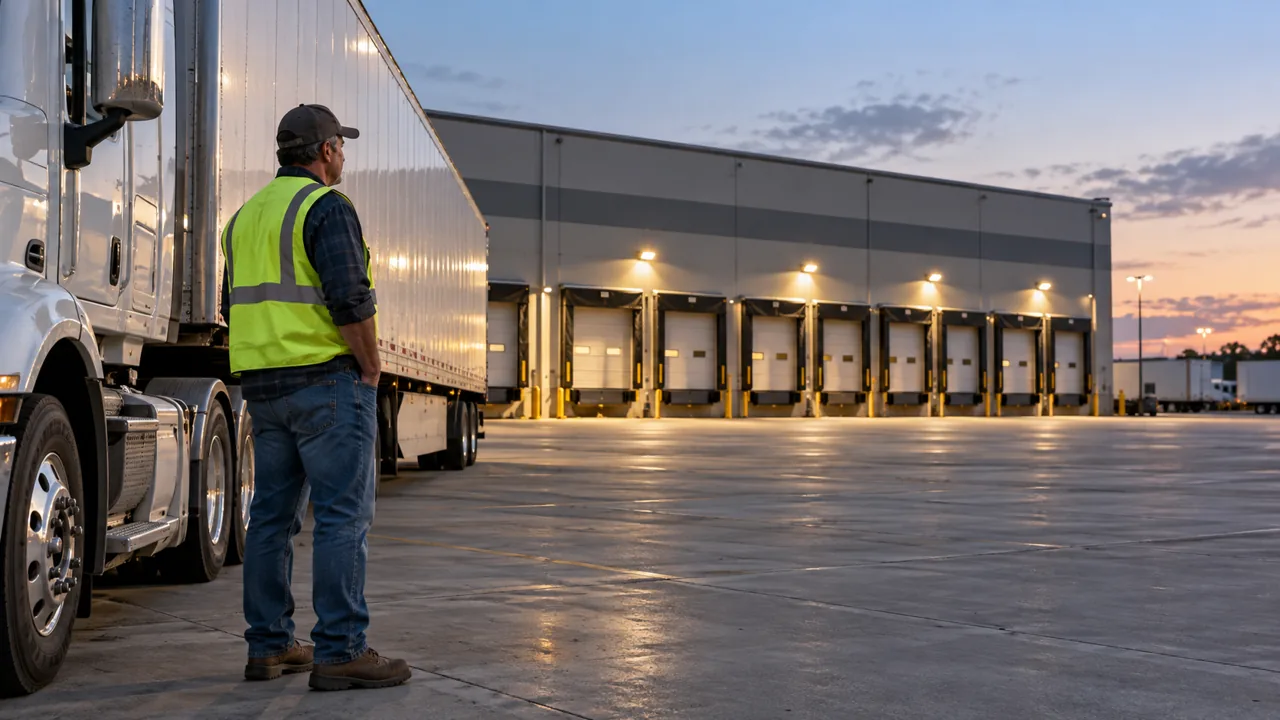
Backing a tractor-trailer is a planning task before it is a steering task. A tight dock becomes harder when a driver discovers a low obstruction halfway through the maneuver, loses sight of a pedestrian, or lets a queue of waiting trucks set the pace. The most useful backing routine creates a clear view of the whole space, keeps communication simple, and leaves room to stop and reset. An experienced driver can use the same routine at a familiar yard because the people and obstacles around the trailer change every day.
Decide whether backing is necessary
On arrival, look for a safer traffic pattern before committing to a reverse movement. Some facilities offer a pull-through area, a designated staging lane, or a preferred direction for approaching the dock. Check the site instructions and ask the yard staff where trucks should wait. Arriving at the wrong door or entering against the yard's normal flow can make a straightforward delivery unnecessarily difficult. A short pause at the gate is often more efficient than reorganizing the entire combination in a crowded work area.
Think about departure while choosing the arrival position. A place that looks convenient for parking may require backing into active traffic later. Consider the turning room the tractor will need, nearby trailers, and access routes used by forklifts or employees. Do not assume that an empty space will remain empty while you unload. If the only available position appears unsuitable, discuss alternatives with the facility and dispatch before using it. The appointment is a reason to coordinate, not a reason to accept a blind maneuver.
Walk the area before moving backward
Get out and look whenever the area or clearance is uncertain. Walk far enough to understand the trailer's intended path, the space beside it, and the ground behind the dock approach. Notice poles, bollards, damaged pavement, drainage channels, wheel stops, trailer corners, and equipment extending into the maneuvering area. Check above as well as at ground level. Canopies, pipes, branches, and building overhangs may sit outside the view available in a mirror or rear-facing camera.
Backing and docking are formal training subjects, not skills a short article can teach completely. The federal entry-level driver training curriculum includes evaluating backing areas, using spotters, and getting out to look. Apply those principles alongside supervised training and the carrier's procedures. A walkaround is useful because it replaces assumptions with current observations. It is not a guarantee that the area will remain clear once the truck starts moving.
Set up for visibility rather than convenience
Before beginning, establish the position and alignment appropriate to the maneuver you have been trained to perform. Favor a setup that lets you monitor the trailer's path as clearly as the site permits. Consider the tractor's front swing as well as the trailer's rear movement. A driver focused entirely on the dock can overlook a vehicle or wall beside the front of the cab. Keep enough room to correct the setup without forcing a sharp, poorly observed change.
There is no universal mirror picture or steering count that works at every dock. Tractor wheelbase, trailer length, axle position, ground slope, and available space alter the geometry. Treat online demonstrations as explanations to discuss during training, not instructions to reproduce blindly. If your setup leaves you unable to judge a critical clearance, stop and improve the view. Getting out again or pulling forward to reset is a normal part of a controlled backing process, not evidence that the driver has failed.
Agree on the spotter's role
A spotter can help monitor a difficult area, but the driver must understand exactly what that person can see. Agree on signals and the intended movement before starting. Use one designated person for instructions rather than trying to follow several helpers at once. Establish a safe position for the spotter, outside pinch points and the vehicle's path, where the driver can maintain visual contact. A helper should never be expected to stand between the trailer and a dock or another fixed object.
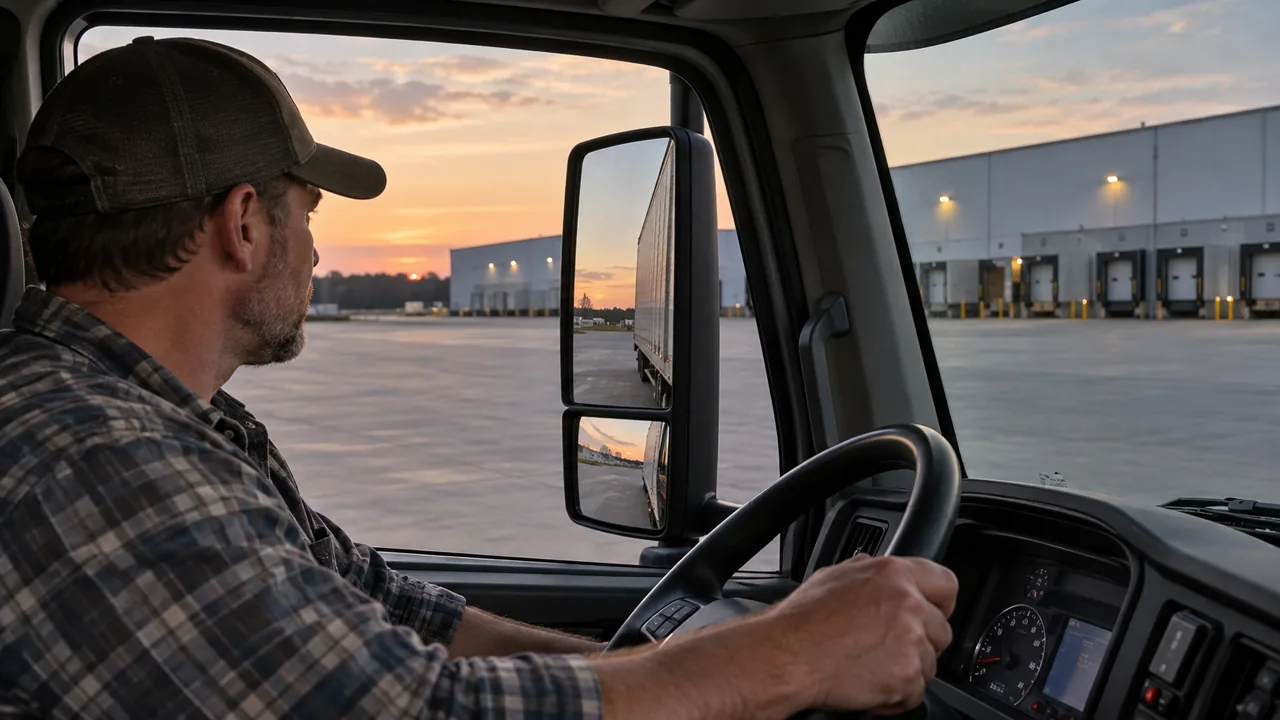
The OSHA guidance on backing safety emphasizes agreed signals, visual contact, and stopping if the driver loses sight of the spotter. Do not interpret silence as permission to continue. A spotter may have stepped aside for another vehicle, become distracted, or moved into a place the driver cannot see. Radios can improve communication, but noise, delayed transmission, or a flat battery can still interrupt instructions. Agree in advance that uncertainty means stop. Keep the exchange brief enough that an urgent warning is not buried in a long explanation.
Control the pace and keep watching the surroundings
Back at a controlled pace appropriate to the vehicle and conditions, ready to stop before a small alignment problem becomes a collision. Check mirrors and other available views repeatedly rather than staring at one reference point. The area that was clear during the walkaround may change as employees cross the yard or another truck starts moving. Do not continue simply because the trailer appears close to its destination. The last portion of a maneuver can contain the smallest clearances and the greatest pressure to finish.
When the picture becomes confusing, secure the vehicle and inspect it again. A pull-up or another walkaround costs less than contact with a trailer, building, or person. Other drivers may wait, but their schedule does not give them a better view of your blind areas. If the yard is too busy to create a safe opening, ask facility staff to coordinate traffic. Make the need specific: explain which lane must remain clear or which pedestrian route crosses the planned movement.
Use cameras and lighting as supporting tools
A camera can reveal part of the area behind the trailer, but it may also hide depth, omit a side obstacle, or present a dirty or delayed image. Know what the system covers before relying on it. Clean lenses through the approved procedure and check that the display belongs to the correct camera view. Mirrors, direct observation, a suitable setup, and spotter communication remain relevant. Technology is most valuable when the driver understands its blind spots as clearly as its useful features.
At night, inspect how yard lighting affects visibility rather than assuming a bright dock makes the whole maneuver easy to see. Glare can hide people beside a trailer, while a dark corner can conceal a low object. Report failed facility lighting and use the truck's approved lighting correctly. Avoid portable arrangements that distract other drivers or create loose equipment in the maneuvering area. If visibility cannot support a safe movement, stop and request a workable alternative.
Finish the maneuver deliberately
Once positioned, secure the vehicle and follow the facility's docking procedure, including communication about restraints, wheel chocks, doors, and unloading. Do not move on a signal you do not understand. Confirm that people and equipment are clear before any repositioning. When unloading is complete, review the departure path again because the yard layout may have changed during the stop. A trailer that backed into an open space may now face a vehicle parked across the planned exit.
The strongest backing habit is the willingness to pause before the view becomes inadequate. Evaluate the space, choose a useful setup, agree on communication, move at a controlled pace, and inspect again when anything changes. Those habits are repeatable across warehouses, terminals, and parking lots. They let a driver concentrate on the actual surroundings instead of trying to complete a maneuver in one attempt for the benefit of an impatient audience.